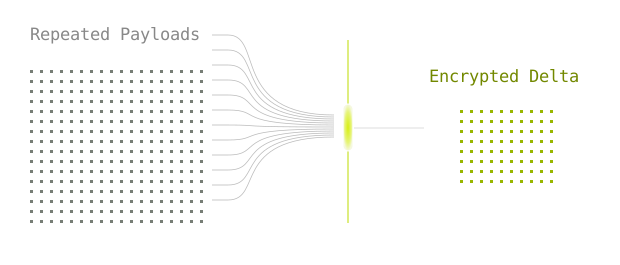
Collapsed Payloads
Repeated responses are replaced by encrypted binary deltas, so the network carries only the state that changed.
 Get Started
QSCS replaces repeated web payloads with encrypted binary state deltas, keeps your backend off the public internet, and deploys in front of the application you already run.
WHAT CHANGES
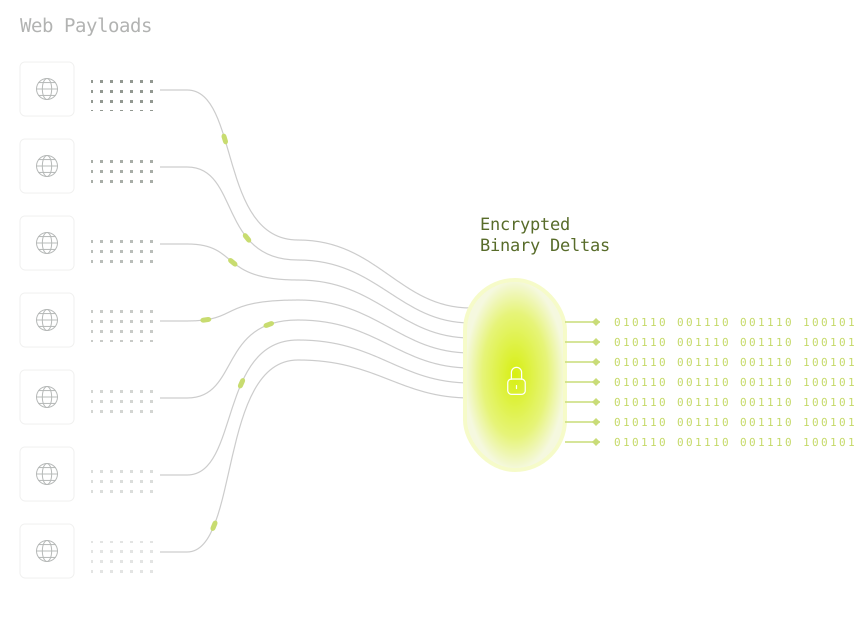
QSCS changes delivery itself: repeated payloads collapse into encrypted deltas, public infrastructure collapses to the edge, and the product keeps running unchanged.
Repeated responses are replaced by encrypted binary deltas, so the network carries only the state that changed.
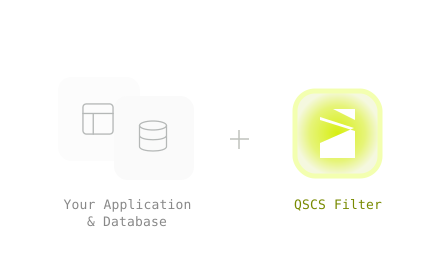
QSCS deploys in front of the application you already run - no SDK, no protocol rewrite, no database migration.
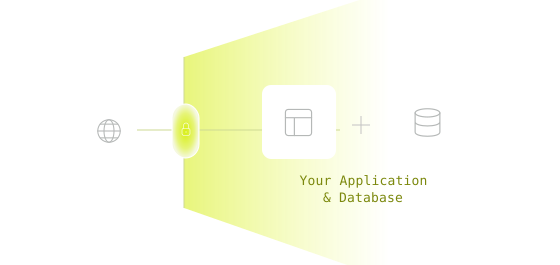
Your application is secure behind the QSCS edge, inaccessible from the internet. This enhances security and lets you focus on business.
QSCS re-compacts inputs at a connection-level, routed only through the domain.
HOW QSCS WORKS
QSCS validates identity once, carries trust through the connection, routes updates predictably, and sends only the encrypted state change needed to keep peers in sync.
Deploy Your First Node →Swipe to follow the path
A client or node proves who it is at the start of the connection. QSCS validates it once, then the session can begin.
After validation, trust carries forward with the connection. QSCS does not repeat checks on every exchange.
Communication moves through a predictable QSCS path instead of renegotiating how each message should travel.
Full payloads stop repeating. QSCS sends only the small encrypted state change needed for the next update.
Peers or clients apply the delta and arrive at the same authoritative state, without carrying web-stack overhead each time.
SECURITY
Security by elimination, not more layers. QSCS reduces the number of exposed services, routes, and configurations that need to be defended.
Fewer systems sit directly on the public path, reducing the number of exposed services that need to be defended.
Trust is established through the QSCS connection, so identity and context do not need to be rebuilt on every exchange.
State changes move through an encrypted QSCS path instead of repeatedly exposing full backend responses.
Your application and database remain behind the QSCS edge, away from the direct public internet path.
WHO QSCS IS FOR
QSCS is designed for teams building distributed, real-time, low-latency, or infrastructure-heavy systems where repeated negotiation, exposed services, and payload overhead create drag at scale.
For teams coordinating state across regions, peers, services, or nodes.
For products where repeated requests, handshakes, or payloads add latency.
For systems carrying too much web-stack complexity just to keep state moving.
For teams that need fewer exposed services, fewer repeated checks, and a smaller public surface.
For services where predictable routing and minimal updates matter more than web abstractions.
STACK COMPARISON
A traditional stack keeps repeating work around every request. QSCS moves communication into a smaller path: less payload, less exposure, fewer repeated checks, and no rewrites.
Full payload, headers, cookies, negotiation.
LB, CDN, session store, tokens, cache.
Public APIs and open ports.
Cookies and bearer tokens.
Rate limiting and scrubbing.
SDK integration or rewrite.
Binary delta, or nothing if unchanged.
One substrate, one config file.
Localhost only, behind the edge.
Per-request Ed25519 signatures.
Absorbed at the edge by construction.
In front of the existing app.
| Traditional stack | QSCS benefits |
|---|---|
| Per request Full payload, headers, cookies, negotiation. | Binary delta, or nothing if unchanged. |
| Infrastructure LB, CDN, session store, tokens, cache. | One substrate, one config file. |
| Backend exposure Public APIs and open ports. | Localhost only, behind the edge. |
| Credentials Cookies and bearer tokens. | Per-request Ed25519 signatures. |
| Traffic floods Rate limiting and scrubbing. | Absorbed at the edge by construction. |
| Adoption SDK integration or rewrite. | In front of the existing app. |
FAQ
No. Spook Systems sits in front of the application you already run. Your backend and database remain in place while QSCS handles deterministic state movement through the substrate.
No. QSCS deploys in front of your existing application. Configure the origin and integrate the browser state module where appropriate; your application and database remain in place.
The QSCS protocol family covers state storage, replication, transport and browser delivery. See How it Works for the roles of each layer and Integration for supported deployment paths.
A proxy forwards requests, a CDN distributes cached content, and a load balancer distributes traffic. QSCS adds a shared-state model that can send only the changes needed to update a participant that already has the previous state.
The application can sit behind the QSCS edge instead of being exposed directly. Encrypted transport and configured cryptographic identity controls reduce the public surface. Application security and patching remain important.
Yes. Sign in to the Control Panel to manage your account, register nodes and configure domains and origins.
Explore Spook Systems and see how deterministic shared state can simplify coordination, recovery, and communication across the systems you already run.