01
ETCP
Quantum identity verification, autonomous pair formation, and link-level conformance across entangled channels.
 Get Started

HOW IT WORKS
QSCS replaces repeated web payloads with encrypted binary state deltas, keeps your backend off the public internet, and deploys in front of the application you already run.
THE CORE INSIGHT
Repeated in every service

Inherited by every application
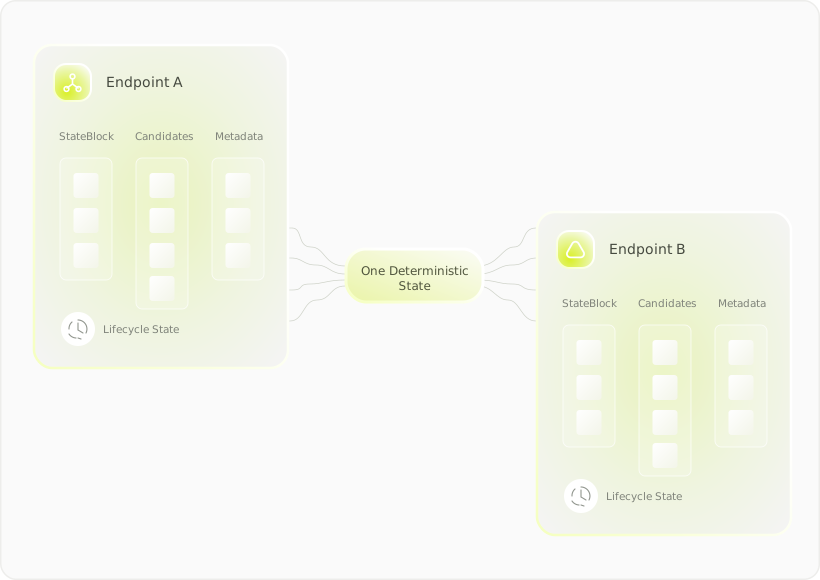
Every distributed system needs a consistent way for participants to agree on state, detect when they diverge, and return to alignment. Spook Systems defines these behaviours once at the protocol level, allowing applications to inherit synchronisation and recovery instead of implementing the same coordination logic repeatedly.
THE MECHANISM
PROTOCOL FAMILY
Quantum identity verification, autonomous pair formation, and link-level conformance across entangled channels.
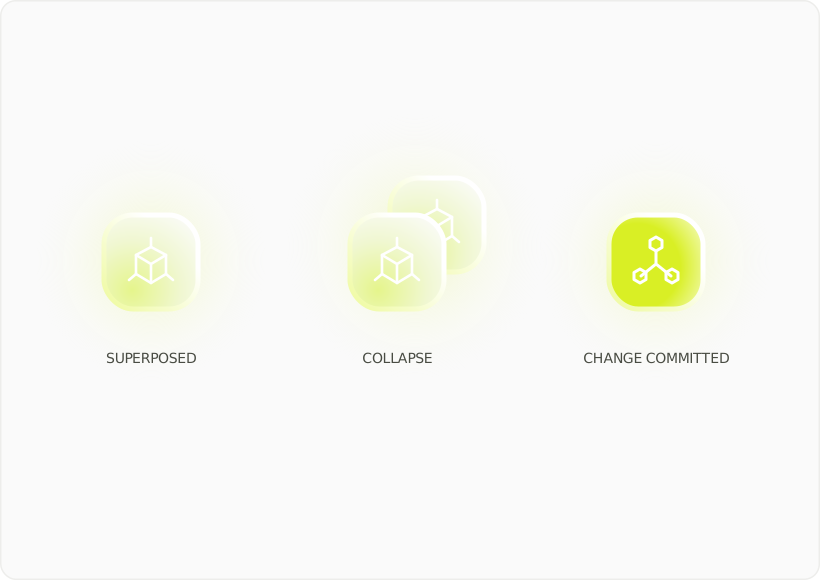
Deterministic shared-state synchronisation via minimal deltas, collapse, decoherence, and re-entanglement.
Multi-register correlation leveraging entanglement-group semantics for coherent cross-partition state binding.
Deterministic multi-node correlation ensuring consistency across geographically distributed quantum domains.
THE CONSEQUENCE
When convergence, divergence, and recovery are defined beneath the application, the machinery built to compensate for their absence is no longer needed in every service.
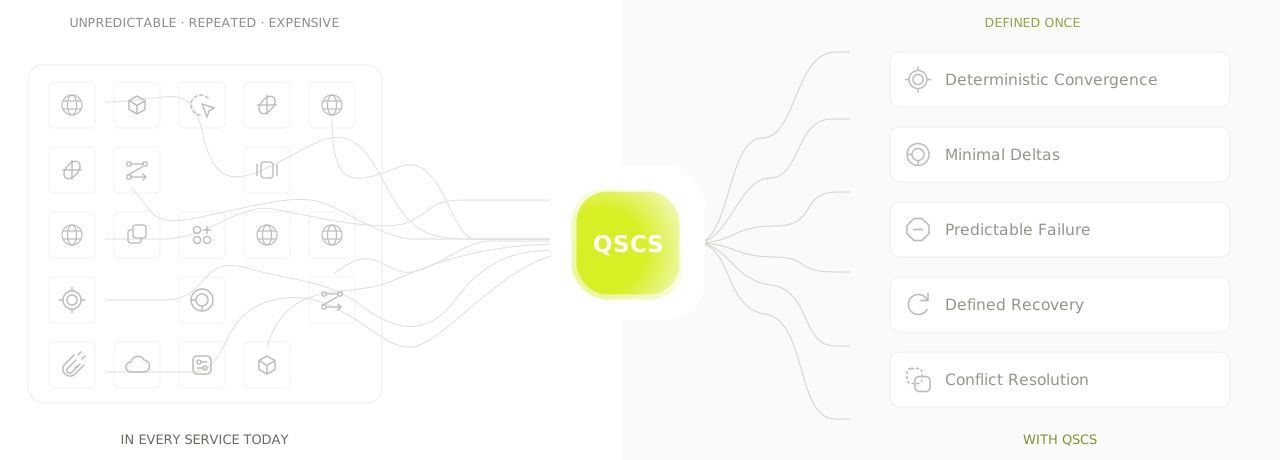
Spook Systems works with the protocols already in place, so HTTP, REST, WebSockets, MQTT, CoAP, SMB, LDAP, SSH, and SQL transports can keep their existing specifications while the QSCS daemon handles correlation, collapse, recovery, and deterministic state transitions underneath.
THE RESULT
Explore Spook Systems and see how deterministic shared state can simplify coordination, recovery, and communication across the systems you already run.